
📋 About the Department
The Electrical Engineering Techniques Department at Al-Samawa Technical Institute is an applied department aimed at preparing technical staff specialized in electrical fields, such as operation and maintenance of electrical systems and control, with a focus on practical training to qualify students for the labor market in energy and industry sectors.
The department contributes to achieving sustainable development goals by integrating modern technologies, renewable energy, and digital transformation, graduating professionals capable of meeting contemporary requirements in electrical fields and industrial control.
🎯 Vision, Mission & Objectives
To establish the Electrical Engineering Techniques Department as a center of scientific, civilizational, and intellectual influence that enriches society, equipped with higher education requirements.
To prepare qualified electrical technical staff responsible for managing electrical machinery, electricity generation methods, electrical networks, power transmission lines, and distribution, equipped with academic knowledge and scientific skills.
Develop technical education by updating curricula and modernizing laboratories according to internationally recognized Good Laboratory Practice (GLP) standards, and involve department staff in specialized qualifying courses. Contribute to community service by holding courses and workshops in various electrical applications, driving construction and development with high quality. Exchange theoretical and practical technical expertise with counterpart technical institutes and colleges and the private sector labor market. Provide a suitable stimulating environment for learning and training. Offer engineering and technical consultations to all state institutions and the private sector.
- Maintenance of electrical devices and implementation of electrical and industrial installations.
- Repairing machinery and winding electric motors.
- Installing, operating, maintaining, and managing various electrical machines and household electrical appliances.
- Scheduling and organizing electrical maintenance workshops and preparing periodic maintenance works.
- Monitoring and following up industrial production lines, their work sequences, and operation.
🔬 Department Laboratories
Objective: Introduce students to basic electronic components such as resistors, capacitors, and diodes.
Practical content: Building simple circuits, studying component characteristics, and experiments on Ohm’s and Kirchhoff’s laws.
Benefit: Establish a knowledge base for understanding advanced electronic circuits.
Objective: Train students to design and analyze electrical circuits.
Practical content: Experiments on parallel and series connections, measuring current and voltage using measuring devices.
Benefit: Enhance ability to handle electrical systems in industrial and domestic applications.
Objective: Teach students methods of establishing electrical networks in buildings and facilities.
Practical content: Wiring, installing circuit breakers and switches, applying safety standards.
Benefit: Prepare students for work in electrical maintenance and domestic/industrial installations.
Objective: Introduce students to principles of digital logic and logic gates.
Practical content: Designing circuits using ICs, studying counters and registers.
Benefit: Enable students to understand basics of computers and digital systems.
Objective: Train students to program Programmable Logic Controllers (PLC).
Practical content: Writing programs for industrial process control, simulating automated operating systems.
Benefit: Qualify students for work in factories and automated systems.
Objective: Apply practical experiments on industrial electrical equipment.
Practical content: Operating electric motors, studying transformers, experiments on power systems.
Benefit: Connect students to industrial reality and develop skills in operating and maintaining equipment.
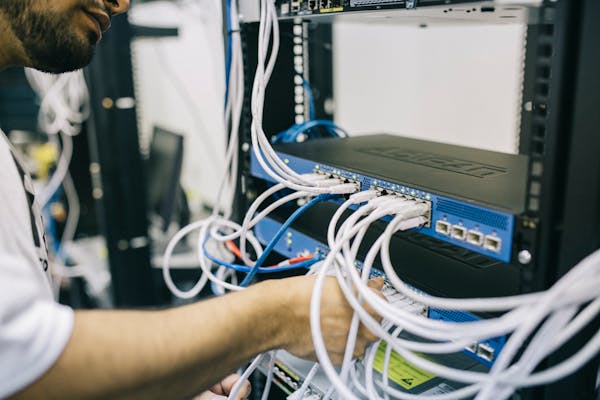
Objective: Teach students basics of computer networks and communications.
Practical content: Installing Local Area Networks (LAN), configuring routers and switches, experiments on communication protocols.
Benefit: Prepare students for work in network management and maintenance.
Objective: Study operation and maintenance of electrical machines.
Practical content: Experiments on various motors (AC/DC), studying performance and efficiency.
Benefit: Qualify students to understand machine operation in factories and facilities.
Objective: Train students to establish industrial electrical systems.
Practical content: Industrial cable routing, installing control panels, applying industrial safety standards.
Benefit: Prepare students for work in electrical engineering projects.
Objective: Teach students how to draw electrical diagrams.
Practical content: Using engineering drawing software (e.g., AutoCAD), preparing installation diagrams.
Benefit: Develop skills in preparing and designing necessary diagrams for practical implementation.
Objective: Train students to use computers in engineering applications.
Practical content: Basic programming, using simulation and analysis software.
Benefit: Enhance digital skills required for analysis and simulation in the electrical field.
🎥 Department Introduction Video
📷 Photo Gallery
📊 Staff & Student Numbers
🔧 Workshops & Courses
- 📅 21/9/2025 – Artificial Intelligence and Internet of Things (Courses – Electrical)
- 📅 2025-12-10 – Professional Project Management (Courses – Electrical)
- 📅 24/12/2025 – Quantum: From Principles of Physical Revolution to Engineering Innovations (Courses – Electrical)
- 📅 18/1/2026 – Quantum Computing (Courses – Electrical)
- 📅 2026-12-01 – Difference between VFD & Soft Starter for Three-Phase Motor Control (Courses – Electrical)
- 📅 2026-07-01 – Calculating Completion Percentage in Engineering Projects (Courses – Electrical)
- 📅 2026-09-03 – Positive Personality and Building Success in Work Environment (Courses – Electrical)
- 📅 2025-02-11 – Role of Artificial Intelligence in Detecting Security Threats (Courses – Electrical)
- 📅 2025-07-09 – Sustainable Energy (Courses – Electrical)
- 📅 2025-01-10 – Virtual Reality (VR) and Augmented Reality (AR) in Digital Systems (Workshops – Electrical)
- 📅 30/10/2025 – Using Solar Energy for Irrigating Agricultural Areas (Workshops – Electrical)
- 📅 2025-10-11 – Impact of Artificial Intelligence on the Electrical Sector (Workshops – Electrical)
- 📅 24/11/2025 – Occupational Safety Procedures in Educational Laboratories (Workshops – Electrical)
- 📅 2025-01-12 – Role of Artificial Intelligence in Improving Student Academic Performance (Seminars – Electrical)

Mr. Nidal Abd Mohammed Khader
Head of Electrical Engineering Techniques Department
Assistant Lecturer / Master’s in Electrical Communications
📧 [email protected]

Yusr Jalal Abdul Sahib
Department Rapporteur
Assistant Engineer / Bachelor’s in Electronics and Communications Engineering
👩🏫 Teaching Staff Members
- 🔹 Prof. Dr. Sabah Mohammed Malikhat – Professor, PhD, Nanotechnology
- 🔹 Mr. Nidal Abd Mohammed Khader – Assistant Lecturer, Master’s, Electrical Communications
- 🔹 Yusr Jalal Abdul Sahib – Assistant Engineer, Bachelor’s, Electronics and Communications Engineering
- 🔹 Mustafa Qasim Hameed – Assistant Engineer, Bachelor’s, Electrical Power
- 🔹 Muslim Nima Wali – Assistant Engineer, Bachelor’s, Electrical Engineering